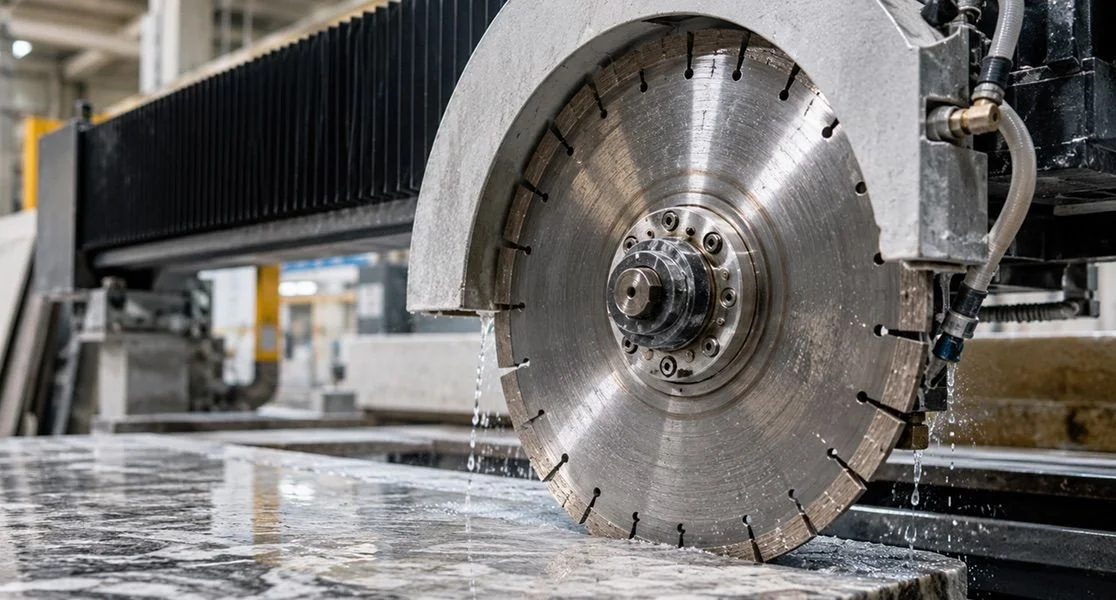

Why diamond blade selection quietly decides your margin
Most countertop shops treat blades like coffee filters: buy the cheapest box, swap when it stops cutting, move on. That habit costs the average fabricator between $8,000 and $30,000 a year in premature blade wear, chipped edges, and rework. The best diamond blades for countertop fabrication in 2026 are not the most expensive ones, they are the ones matched to your material mix, your saw's RPM, and your actual production volume.
A blade is a consumable that touches every job you produce. If your CNC operator picks the wrong bond for a quartzite slab worth $2,400, one chipped edge can eat six months of blade savings. The math is unforgiving, and it rewards shops that treat tooling as a data point, not a supply closet item.
How to read a diamond blade spec sheet without getting fooled
Manufacturers love acronyms and marketing terms. Strip it back to five things that actually matter for countertop work:
- Bond hardness: Soft bond releases diamonds fast, cuts hard materials cleanly. Hard bond holds diamonds longer, better for softer stones. Get this wrong and you either burn the blade or glaze it.
- Segment height: Taller segments (10mm and up) last longer but cost more upfront. Shorter (7mm) is fine for high-volume shops that rotate stock quickly.
- Diamond concentration: Higher concentration means more cutting points, slower wear, higher cost. For quartz, go higher. For soft marble, lower is fine.
- Rim type: Continuous rim for chip-free finishing cuts, segmented for aggressive rough cuts, turbo for a balance.
- RPM rating: Match it to your saw. Running a blade at the wrong RPM is the fastest way to destroy it and possibly hurt someone.
If a supplier cannot answer these five questions in 60 seconds, keep shopping.
Best diamond blade type by material (2026 shortlist)
This is the practical breakdown. Do not overthink it, but do not oversimplify either. Different slabs, different blades.
| Material | Recommended bond | Rim type | Typical life (linear ft) | Best for |
|---|---|---|---|---|
| Granite | Medium | Segmented or turbo | 800 to 1,500 | Daily production, mixed jobs |
| Quartz (engineered) | Hard | Continuous rim | 600 to 1,200 | Chip-free edges, high-end kitchens |
| Quartzite | Soft | Turbo | 400 to 900 | Hard natural stone, exotic colors |
| Marble and limestone | Hard | Continuous rim | 1,200 to 2,500 | Soft stones, polished finish |
| Porcelain slab | Very soft | Continuous rim, thin kerf | 200 to 600 | Large format, thin panels |
| Ultra-compact (Dekton, Neolith) | Very soft, high concentration | Continuous rim | 150 to 500 | Sintered stone, high hardness |
Notice quartzite and ultra-compact eat blades faster. Price them into your quote, not into your loss column.
The specs that separate a $180 blade from a $450 blade
Two 14-inch continuous rim blades for quartz can differ 2.5x in price. The differences are real, and they show up in three places:
- Diamond quality and placement: Premium blades use synthetic diamonds with controlled crystal shape, placed in a precise matrix. Cheap blades use mixed-grade diamonds scattered randomly. Result: premium blades cut faster with less pressure and stay sharp longer.
- Steel core quality: A cheap core warps under heat. A warped blade cuts wavy edges and vibrates, which chips your slab. Look for laser-welded segments and tensioned steel cores.
- Consistency batch to batch: The premium brands you have heard of (Adria, Weha, Cyclone, Alpha, Diarex, Terminator) invest in QC. Off-brand blades vary wildly between production runs, so one box works great and the next one glazes on the first cut.
Rule of thumb: for daily production on a bridge saw or CNC, premium blades pay back within 90 days on reduced downtime alone. For a hobby shop or backup blade, mid-tier is fine.
Water, RPM, and feed rate: the free performance upgrade
You can buy the best blade on the market and destroy it in a week with bad operating conditions. The three variables that matter most:
- Water flow: Diamond blades need water on both sides of the blade, minimum 2 gallons per minute for a 14-inch blade. Dry cutting kills the blade and warps the slab.
- RPM: Every blade has a sweet spot printed on the label. Running too fast burns segments, too slow glazes them. If your saw does not let you adjust, match the blade to the saw's fixed speed.
- Feed rate: Let the blade cut, do not force it. Excessive pressure heats the segment, weakens the bond, and wears the blade in a fraction of its rated life.
How to actually track blade cost per square foot
Here is what separates a $2M shop from a $10M shop: the $10M shop knows exactly how many square feet each blade produced before it was retired. The $2M shop guesses.
Tracking blade consumption used to require spreadsheets that nobody updated. In 2026, it should live inside the same system that tracks your slab inventory, your quotes, and your job costs. When a job is completed in SlabWare, the fabricator can log the blade used, the linear feet cut, and the material type. Over a month, patterns emerge: which supplier's blades actually last, which operators are heavy on tooling, which materials eat blades faster than you priced them for.
That data changes purchasing conversations. Instead of buying blades on gut feel or on a rep's promise, you buy based on your own numbers. Shops using SlabWare typically cut annual tooling spend by 15 to 25 percent within the first year just by seeing the real numbers for the first time.
Red flags when buying blades (and suppliers) in 2026
- Supplier cannot tell you the diamond concentration or bond hardness.
- Price is 40 percent below market with no explanation.
- No warranty or return policy on defective segments.
- Blade label lists a wide RPM range with no target (e.g., 1,500 to 6,000 RPM).
- Segments not laser-welded (silver-brazed segments can fly off, which is a real safety issue).
- Rep pushes one blade for every material. There is no universal blade.
The 2026 buying checklist
Before you place your next tooling order, run through this list:
- Do you know your material mix by percentage (granite vs quartz vs quartzite vs porcelain)?
- Do you have blade life data from the last 12 months, or are you guessing?
- Are your operators trained on correct water flow and feed rate?
- Is your saw's RPM matched to the blades you are ordering?
- Do you have a system to log which blade was used on which job, so you can calculate real cost per square foot?
If you answered no to three or more, the problem is not the blade brand, it is the data. Fix the visibility first, and the right blade choice becomes obvious.
Frequently asked questions
How long should a diamond blade last on granite countertop fabrication?
A quality medium-bond 14-inch blade should cut between 800 and 1,500 linear feet of granite before retirement, depending on granite hardness, water flow, and feed rate. Premium blades on the high end of that range, budget blades on the low end. If you are seeing less than 600 feet, either the blade is wrong for your material or your operating conditions need attention.
What is the best diamond blade for cutting quartz countertops in 2026?
For engineered quartz, use a hard-bond continuous rim blade with high diamond concentration. Continuous rim gives you chip-free edges on the visible seam, and the hard bond stands up to quartz's abrasiveness. Brands like Adria, Alpha, and Diarex all make solid options in the $250 to $400 range for a 14-inch blade.
Can I use the same blade for granite and quartz?
Technically yes, but you will get poor results on at least one of them. Granite prefers a medium bond with segmented or turbo rim, quartz needs a hard bond with continuous rim. Using one blade for both means faster wear, more chipping, and higher cost per square foot in the long run. Two blades pay for themselves quickly.
How do I know if I am overpaying for diamond blades?
Calculate your true cost per square foot cut, not the sticker price. A $400 blade that cuts 1,200 feet is cheaper per foot than a $180 blade that cuts 400 feet. Most shops never do this math because they do not track it. Systems like SlabWare let you log blade consumption against jobs, so you finally see which supplier actually delivers value.
Do premium diamond blades really justify the price?
For a shop producing more than 200 square feet per week, yes almost always. Premium blades last two to three times longer, cut faster (which speeds throughput), and produce fewer chips (which cuts rework). For a low-volume shop or a backup blade, mid-tier is usually enough. The break-even point is roughly 90 days of daily use.
How often should I dress a diamond blade?
Dress when you notice slower cutting, glazing on the segments, or a change in cut sound. In heavy production, that can be weekly. Use a dressing stone or an abrasive brick, running the blade at low speed with full water flow. A properly dressed blade can regain 80 to 90 percent of its original cutting speed and extend total life significantly.
If you want to know more, get in touch with our team by clicking here.
Keep reading