
Every stone fabricator knows the feeling of a cold proposal. A homeowner walks into your showroom, runs their hand across a polished island display, picks up three 4x4-inch quartz samples, and leaves with a smile. Your estimator spends forty-five minutes calculating square footage, factoring in edge profiles, mapping out sink cutouts, and drafting a clean, professional quote. You send it off that evening.
Then, silence.
Three days later, you follow up. "We’re still thinking about it," they say. Or worse: "We’re looking at a few other options."
In the stone fabrication industry, "maybe" is the most expensive word in business. "No" is clean—it lets you clear the pipeline and focus on real prospects. But "maybe" lingers. It consumes your sales team’s time, cluttering your CRM with follow-up tasks, and leaving thousands of dollars in potential margin floating in limbo.
Most shops assume that a prospect who hesitates is shopping on price. They assume the competitor down the road offered $5 less per square foot, or that the homeowner is waiting for a discount. But industry data tells a completely different story. Prospects don't stall because of $300 on a $7,000 project. They stall because of uncertainty.
When a homeowner is about to spend $8,000 on a piece of natural stone or quartz that will be permanently glued to their custom cabinetry, they aren't afraid of the money—they are terrified of making a permanent, expensive mistake.
If you want to convert more leads without slashing your margins, you don't need cheaper stone or a bigger discount. You need to eliminate the fear of the unknown. Here is how leading marmolerías are transforming hesitation into signed contracts—and why visual clarity is the ultimate closing tool in surface sales.
The Psychology of Hesitation: Why Countertop Prospects Stall
To close more sales, you must first understand what is happening inside your prospect’s head when they walk out of your showroom holding a physical sample.
1. The Scale Disconnect
A 4x4-inch sample swatch is a terrible representation of a full 120x65-inch slab. This is especially true for movement-heavy natural stones like Calacatta marble, Taj Mahal quartzite, or exotic granites with sweeping veins. A homeowner looking at a tiny swatch of Taj Mahal sees a soft beige background with a hint of gold. What they cannot see is how those massive diagonal gold veins will sweep across an eleven-foot waterfall island. Because they cannot mentally expand a coaster-sized square into a 3D kitchen, their brain registers risk. When humans perceive risk without clarity, their default response is inaction.
2. The Context Blind Spot
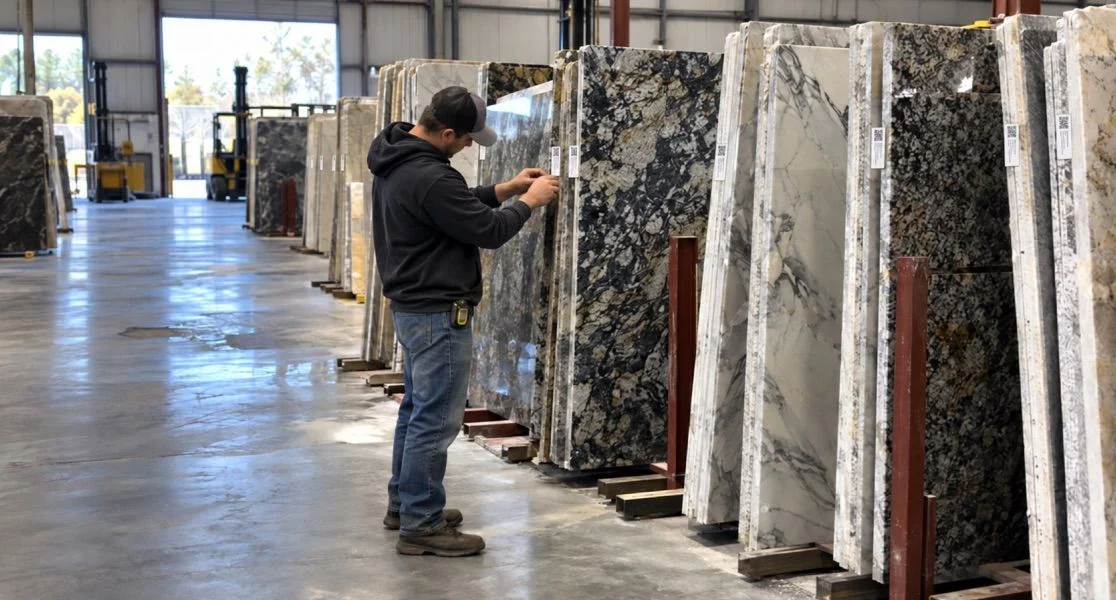
Even if a customer comes to your yard and looks directly at a full slab on the A-frame, they are looking at it vertically, under industrial fluorescent lights, isolated from their home environment. They are trying to imagine that slab laying horizontally, surrounded by their specific dark navy cabinets, brushed brass hardware, oak flooring, and warm kitchen lighting. The inability to picture the stone in their actual room creates friction.
3. The Co-Decision Dilemma
In surface sales, the person visiting your showroom is rarely the sole decision-maker. They take a picture of the slab with their phone, drive home, and try to explain it to their partner or spouse. The phone photo is washed out by glare, the yard background looks like a chaotic warehouse, and the partner says, "I don't know... it looks a bit dark." Suddenly, the enthusiasm generated in your yard evaporates at the dinner table.
[ Lack of Visual Clarity ] ➔ [ Customer Anxiety ] ➔ [ Delayed Decisions ] ➔ [ Lost Deals ]
When you understand these three psychological hurdles, your sales strategy changes. Closing more jobs isn't about pushing harder; it's about removing visual anxiety.
Why Speed and Clarity Beat Price Every Single Time
Many shop owners believe that if they just lower their price by 5%, their close rate will jump. However, margin erosion is a trap that fails to solve the root problem.
In high-ticket home improvement projects, price is rarely the primary driver of the final decision. Once a homeowner has decided to remodel their kitchen, they have already committed to spending significant money. What they want above all else is confidence.
Confidence = Speed of Visualization + Precision of Information
The shop that wins the job is almost always the one that provides the highest level of confidence in the shortest amount of time.
Consider two competing shops pitching the same homeowner on a $7,500 kitchen renovation:
Shop A (The Traditional Approach): Sends a PDF estimate with itemized line items: "65 sq ft - Calacatta Gold Quartz - $115/sq ft." Attached to the email is a low-res stock photo of a generic Calacatta swatch downloaded from the manufacturer's website. They tell the customer: "Let us know if you'd like to swing by the yard to see the chapa in person."
Shop B (The Experience-Driven Approach): Sends an interactive digital quote within two hours. Attached to the proposal is an interactive link showing the exact slab from their live inventory rendered directly onto a photo of the customer's existing kitchen. The customer can toggle between Calacatta Gold and Taj Mahal Quartzite on their smartphone, show their spouse over dinner, and click "Approve."
Shop B will win that contract nine times out of ten, even if their quote is $500 higher. They didn't just sell stone; they sold certainty.
The Economics of Conversion: Why a 10% Bump Changes Everything
To understand why fixing your close rate is the highest-leverage activity in your business, you have to look at the math behind your sales pipeline.
Most shops spend considerable money on marketing—Google Ads, Facebook campaigns, home show booths, local magazine spreads, and sales rep salaries. Let’s look at two mid-sized shops generating 60 qualified leads per month with an average job value of $7,000.
| Metric | Shop A (30% Close Rate) | Shop B (40% Close Rate) | Difference |
| Inbound Leads / Month | 60 | 60 | 0 |
| Signed Jobs / Month | 18 | 24 | +6 Jobs |
| Average Job Value | $7,000 | $7,000 | $0 |
| Monthly Gross Revenue | $126,000 | $168,000 | +$42,000 |
| Annual Gross Revenue | $1,512,000 | $2,016,000 | +$504,000 |
Notice what happened here: Shop B generated over half a million dollars in additional revenue per year without spending a single extra dollar on advertising.
They didn't buy more leads. They didn't hire extra salespeople. They simply converted more of the "maybes" into "yeses."
When you increase your conversion rate, your cost per acquired customer drops drastically, your gross margin expands, and your sales team becomes significantly more efficient. This is why focusing on conversion is far more profitable than pouring more money into top-of-funnel marketing.
Showing What They Want to See: The Power of Contextual Sales
If visual clarity is the key to closing deals, how do you deliver it consistently without turning your sales process into a slow, expensive design agency?
The traditional solution was hiring a 3D designer to build complex CAD renderings of every customer's kitchen. But architectural rendering software takes hours to set up, requires skilled technicians, and costs hundreds of dollars per project. Doing a full 3D design for an unclosed lead is a quick way to burn through profit margins.
You don't need a full CAD architectural model to close a countertop sale. You need contextual visualization.
Contextual visualization means showing the customer's actual stone option mapped onto their actual space in real time. It answers the only question the homeowner truly cares about: "What is this specific stone going to look like in my house?"
When you give prospects the ability to visualize materials contextually:
Decision time drops from weeks to hours: Instead of needing three visits to your yard to double-check their choice, they can see the option instantly.
Upselling becomes effortless: A customer who came in planning to buy basic Level 1 white quartz can see how dramatic a premium quartzite looks in their space. When they see the visual upgrade, trading up to a high-margin material becomes their choice, not a sales pitch.
Buyer’s remorse disappears: Because the customer saw a realistic representation before cutting began, post-install complaints about movement, pattern density, or color matching disappear.
Enter SlabSnap: Turn Your Inventory Into a Real-Time Sales Engine
This is precisely why we built SlabSnap directly inside SlabWare.
SlabSnap is an AI-powered surface visualizer designed specifically for countertop fabricators, stone shops, and kitchen showrooms. It bridges the gap between your physical chapa inventory and your customer’s imagination—without requiring CAD files, complex design software, or technical expertise.
Here is how SlabSnap transforms your sales workflow and turns "maybes" into signed jobs:
[ Step 1: Upload Room Photo ] ➔ [ Step 2: Select Live Inventory ] ➔ [ Step 3: Instant AI Render ]
1. Zero-Friction Client Experience
Traditional design visualizers require customers to download third-party applications, set up accounts, or navigate clunky 3D editors. SlabSnap eliminates all friction.
With SlabSnap, your sales rep generates a lightweight, customized web link and sends it straight to the client’s phone via text or email. The client opens the link on their device, snaps a photo of their current kitchen, bathroom vanity, or outdoor space, and instantly begins testing materials.
2. Powered by Your Actual Slab Inventory
Most online visualizers use generic stock images of quartz or granite. This creates a major disconnect when the customer arrives at your yard and the real slab looks nothing like the digital rendering.
SlabSnap connects directly to your SlabWare live inventory. When a client renders a stone in their kitchen, they aren't looking at a generic factory swatch—they are looking at the actual high-resolution photo of the slab sitting on your A-frame right now. If a customer loves what they see on their screen, your salesperson can reserve that specific slab with a single click before another rep sells it.
+-----------------------------------------------------------------------+
| SLABSNAP FLOW |
| |
| [ Customer Room Photo ] + [ Live Chapa Photo ] = [ Instant AI Render ] |
+-----------------------------------------------------------------------+
3. Native Integration with Quotes and Proposals
SlabSnap isn't a standalone tool that sits isolated from your business operations. It lives directly inside your SlabWare sales workflow.
When your estimator builds a quote in SlabWare, they can attach a pre-loaded SlabSnap visualizer link containing the exact materials short-listed in the proposal. The client receives the formal estimate, opens the visualizer link, sees the stone mapped across their space, and signs off on the contract right from their phone.
4. Interactive Controls That Drive Engagement
SlabSnap includes built-in interactive tools designed to finalize decisions:
Before / After Toggle: Allows clients to slide back and forth between their current worn-out countertops and the proposed new stone.
Selection Submission: Once the client finds the winning material, they click "Send Selection to Team," instantly notifying your sales rep that the client is ready to lock in the job.
PDF Summary Export: Your team can download a polished PDF report containing the original room photos, rendered variations, and selected stone specs—perfect for appending to formal contracts or passing to your fabrication team.
4 Actionable Strategies to Implement in Your Showroom Today
Equipping your business with visual technology is step one. Step two is structuring your sales process to maximize its impact. Here are four practical strategies top-performing fabricators use to drive conversion rates past 40%:
Strategy 1: Make Visuals the Standard First Follow-Up
Instead of sending a text that says "Hi Sarah, just checking in to see if you got our quote," send a message powered by SlabSnap:
"Hi Sarah! I know it’s tough picturing how that Taj Mahal quartzite will look with your navy cabinets. I set up a quick visual link for you—just snap a photo of your kitchen and you can test our actual slabs directly on your counters. Take a look here: [Link]"
This shifts the conversation from a sales pitch back to an engaging, interactive design process.
Strategy 2: Use "Limit Alerts" to Gauge Buyer Intent
Inside SlabSnap, you can manage how many upload and rendering attempts each customer link receives. Track client activity closely: a prospect who opens their link three times and uses all their allocated rendering credits is showing high buying intent.
When you see a client hit their usage limit, your sales rep has the perfect reason to reach out: "Hey Mark, I saw you were testing a few options on your kitchen island! I just added 5 more rendering credits to your link so you can try our new Calacatta arrival."
Strategy 3: Eliminate the "Let Me Ask My Spouse" Objection
When a prospect says they need to consult their partner before signing, don't let them walk out with just a business card. Generate a SlabSnap link while they are standing in front of you, hand them their phone, and say:
"Take this home, snap a quick photo of your kitchen tonight during dinner, and show your spouse what this slab looks like in your actual room. You can both test a couple of options together on the couch."
By giving them a tool that involves their partner visually, you prevent the enthusiasm from dying off once they leave your yard.
Strategy 4: Upgrade the In-Showroom Consult
Set up a tablet or large touch screen in your showroom or sales office. When clients bring in photos of their remodel, upload them directly to SlabSnap on the spot. Walk them through your live inventory on a display screen, showing them how different stone movements interact with their space before walking out to the yard. By the time they step into the warehouse to inspect the physical slab, the sale is already 80% closed.
Stop Leaving Margin on the Table
In the modern stone fabrication market, customer expectations have evolved. Homeowners expect the same seamless, visual, and digital experiences from their local surface provider that they get from every other retailer.
Relying on tiny physical swatches, static PDF estimates, and hallway verbal promises is a recipe for stalled deals and lost margins. Stone shops that thrive over the next decade will be those that eliminate buying friction, build visual confidence, and make it effortless for customers to say "yes."
You don't need to spend tens of thousands of dollars on complex design software or double your marketing budget to grow your business. You just need to show your customers what they want to see.
Ready to Turn Your "Maybes" Into Signed Jobs?
Transform your sales process and start rendering your live slab inventory inside your customers' homes today.
👉 Schedule a live SlabSnap demo at SlabWare.com or reach out to our team to activate SlabSnap for your account!
Prefer to explore more articles? Click here to visit the SlabWare Blog
Keep reading