
IndexBox just published a global forecast on the binder inside every engineered slab. Fab shops that SKU everything as 'quartz' already lost the argument.
IndexBox just published a global market forecast for the resin that binds engineered quartz. Read that twice. Not the slab, the binder inside the slab. Somebody with capital is modeling the two liters of adhesive holding your countertop together, and the average fab shop still writes 'quartz white 3cm' on the invoice and hopes nobody asks a follow-up.
Somebody Priced the Binder. It Wasn't the Fab Shop
The IndexBox report doesn't cover engineered quartz slabs. It covers the resin. That is a different animal. Unsaturated polyester, methacrylate, epoxy, all tracked as separate line items with pricing bands, volume forecasts, and geographic splits. Analysts are treating the binder as a standalone commodity because they see it as the pinch point of the entire engineered stone category.
The manufacturer already knows which resin, at what ratio, in which SKU, from which plant, on which shift. The insurer wants to know. The class-action lawyer definitely wants to know. The average yard? Sticky notes and a color card. That gap is the story.
The Reformulation Wave Already Landed in the Yard
Read what is happening upstream. Silicosis diagnoses climbing in the UK and Australia. OSHA rollbacks that everyone in the industry knows will get litigated the moment the next transplant case hits the docket. Australia already banned engineered stone outright. EU labor ministries circling. Manufacturers are not standing still. They are reformulating. Lower silica ratios, alternative binders, marketing lines like 'low-crystalline' or 'next-gen quartz.'
Which means two slabs that look identical coming off the truck are not identical. One might be 90 percent silica, old formula, high litigation exposure. The other 40 percent silica, new binder chemistry, cleared under a newer worker-safety spec that did not exist eighteen months ago. Same color code. Same brand. Different molecule.
Nothing on the standard bill of lading tells the fabricator, the installer, the insurer, or the homeowner which one they got.
Two 'White Quartz' Slabs Are Not the Same Slab
Sit with this list. It is what actually differs, slab to slab, on what most yards still book as one commodity SKU:
- Silica content, which drives the dust story on the saw and the OSHA exposure math
- Resin type, which drives yellowing, seam adhesion, flame behavior, and yield
- Batch date, which drives whether the slab is pre or post the manufacturer's reformulation announcement
- Country of production, which drives tariff exposure and quality variance
- Quartz chip and pigment source, which drives color drift between two boxes stamped the same name
A single 'White Quartz' line item flattens all of that into a color and a thickness. That was convenient in 2019. It is indefensible in 2026, the second a lawyer, an insurer, or a spec-driven designer asks for batch-level detail.
The Yards That Can Answer 'Which Batch' Win the Next Cycle
Watch what is already moving. Insurance carriers underwriting fabricators are running silica-specific questionnaires. Large builder customers are requesting supplier declarations by batch, not by brand. Architects on premium residential specs are naming low-crystalline product lines directly on the drawing. Legal teams on remodel disputes are asking which lot was installed, in case they need to line it up against a pending class action.
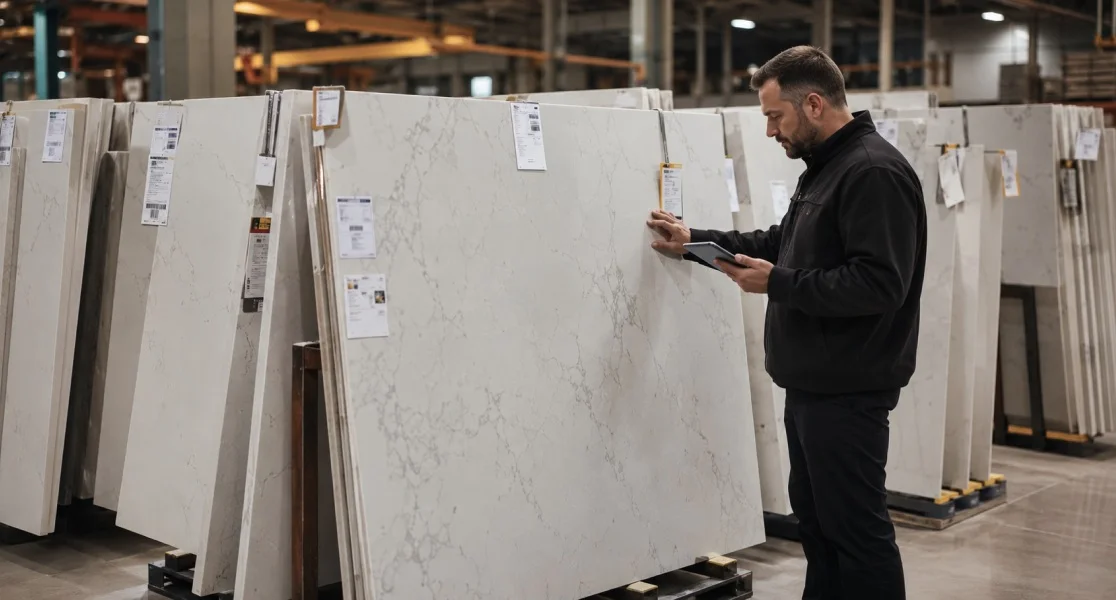
The differentiator is not price and it is not turnaround. It is whether the yard can answer the question. Shops that photographed and tagged every slab at intake can pull the manufacturer, batch, arrival date, cost, and formulation spec in about ten seconds. Shops running spreadsheets and grease pencil cannot.
The next lawsuit is not going to ask whether the shop carries quartz. It is going to ask which batch, from which plant, produced when, was installed in the house on 227 Cherry Street. Yards that cannot answer will settle.
Material Intelligence Is the Moat Now
This is where the fab shop makes its call. The market analysts already treat the binder as a tradable, tracked, forecastable commodity. Manufacturers already version their SKUs by reformulation date. Insurers and customers are learning to ask by batch. The only actor still pretending the world is a color card is the yard.
Tools like Slabware exist for exactly this fight. Every slab photographed at intake, tied to manufacturer, batch, arrival date, cost, and the job it goes out on. Not because it is cute software. Because the question 'which slab, which batch, which spec' is about to become an insurance underwriting question, a legal discovery question, and a procurement question in the same twelve months. Shops running Slabware are not safer because of the login screen. They are safer because they can answer.
The yards betting on 'we carry quartz' as a strategy are betting against a supply chain that is becoming legible at every layer above them. IndexBox is modeling the resin. Manufacturers are versioning the slab. Regulators are asking for silica ratios. Lawyers are asking for batch numbers. Being the last opaque node in a legible chain is not a moat. It is a target painted on the yard.
Get legible before the market forces it. The shops that already did are quietly taking the specs the loose yards will not even see coming.
Sources
Keep reading